
A massage in Tarifa that combines heat and cold can help prepare muscles for manual work, support comfortable movement and complement recovery after physical activity. Heat and cold produce different physiological responses, and when used appropriately, they can be integrated into Sports Massage and Deep Tissue Massage to address muscular tension and adapt the treatment to individual needs.
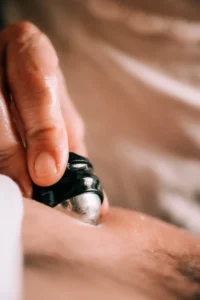
At Tarifa Sports Massage, I use hot stones over larger muscular areas, such as the paravertebral muscles and around the shoulder blades, while a frozen metal ball allows controlled, localised cooling when appropriate. In selected sessions, I can also alternate between heat and cold, introducing different thermal stimuli alongside manual techniques.
For active people in Tarifa, this approach can be particularly relevant. Kitesurfing, wingfoiling, surfing, climbing, running and cycling place repetitive demands on the body. Muscles may feel tight, tired or restricted after physical effort, even when there is no injury. A massage in Tarifa with Hot or Cold Therapy can support your recovery.
The purpose is not to make the massage more intense, but to choose the appropriate technique for the area being treated and the needs of the individual.
How Do Heat and Cold Work During Massage?
Heat and cold influence the body in different ways. Heat generally promotes vasodilation, increasing local blood flow, while cold lowers tissue temperature and generally causes vasoconstriction in the exposed area.
These responses can serve different purposes during a massage. Warmth may help prepare larger muscular areas for manual work, contribute to relaxation and reduce the sensation of stiffness. Localised cooling provides a different thermal and sensory stimulus when appropriate.
The effects depend on the temperature, duration of application, area being treated and individual response. Neither heat nor cold is automatically better in every situation.
How I Use Heat Therapy Massage in Tarifa
I use hot stones over larger muscular areas, particularly around the paravertebral muscles, shoulder blades and upper back, where warmth can complement manual techniques.
The heat can be incorporated into the preparation for deeper tissue work, stretching and movement. Rather than being used simply for comfort, it becomes an additional tool within the treatment.
Research supports the use of heat alongside stretching. A systematic review involving 12 studies and 352 participants found that combining heat with stretching produced greater improvements in range of motion than stretching alone.
The studies investigated several heating methods, including hot packs and therapeutic heating devices, rather than specifically examining hot stones during massage. Nevertheless, the findings provide relevant evidence for the potential benefits of combining heat with stretching.
Research reference: Jiro Nakano, Cristiane Yamabayashi, Alex Scott and W. Darlene Reid — The Effect of Heat Applied with Stretch to Increase Range of Motion: A Systematic Review (PubMed)
How I Use Cold Therapy
In selected treatments, I use a frozen metal ball to provide controlled, localised cooling.
This allows me to focus on a smaller area rather than cooling a large part of the body. The application can be incorporated into a session alongside manual work on the surrounding soft tissues.
Cold therapy has also been studied in sports recovery. A systematic review and meta-analysis of 32 randomised controlled trials involving 1,098 participants found that heat and cold interventions could help reduce pain associated with delayed-onset muscle soreness (DOMS). The results varied according to the intervention and timing, and the findings do not establish that every cold application produces the same effects.
This research examined different thermal interventions, not specifically a frozen metal ball used during massage. I therefore use localised cooling selectively rather than applying it as a standard protocol to everyone.
Research reference: Heat and Cold Therapy Reduce Pain in Patients with Delayed Onset Muscle Soreness: A Systematic Review and Meta-analysis
What Is Intermittent Hot and Cold Therapy?
Intermittent hot and cold therapy involves alternating between warm and cold stimuli. In sports recovery research, this is commonly studied as contrast water therapy, which traditionally involves alternating warm and cold water immersion.
A systematic review and meta-analysis found that contrast water therapy could reduce muscle soreness and strength loss compared with passive recovery after exercise. However, the included trials had a high risk of bias, and the evidence did not establish clear superiority over other active recovery methods.
During selected massage sessions, I apply the general principle of alternating thermal stimuli in a more localised way. For example, I may use a hot stone over a larger muscular area and introduce controlled cooling with the frozen metal ball in a selected area before returning to manual techniques.
This is not the same protocol as contrast water immersion. It is a way of adapting temperature applications to the treatment rather than relying on a single stimulus throughout the session.
Research reference: François Bieuzen, Chris M. Bleakley and Joseph Thomas Costello — Contrast Water Therapy and Exercise-Induced Muscle Damage: A Systematic Review and Meta-analysis
Why Can Hot and Cold Therapy Be Useful After Physical Activity?
After demanding physical activity, muscles may feel fatigued, tight or temporarily restricted. An individualised Sports Massage or Deep Tissue Massage can help address the sensation of muscular tension and support comfortable movement.
For people who spend long hours kitesurfing, surfing, climbing, cycling or training, a massage in Tarifa offers an opportunity to focus on the areas experiencing repeated physical demands.
At Tarifa Sports Massage, I can combine selected temperature applications with deep tissue techniques, fascial work, trigger point techniques, stretching and cupping, depending on the individual and the purpose of the session.
The treatment is adapted to the person rather than following an identical routine for everyone. Heat and cold are complementary tools, not a replacement for appropriate manual techniques or professional assessment when symptoms require it.
Safety and Treatment Boundaries for a Massage in Tarifa
Heat and cold therapy are not suitable for every person, condition or area of the body.
Heat requires particular care when sensation is reduced or altered, or when recent trauma, significant swelling or another condition makes its use inappropriate. Cold also requires caution, especially where circulation or sensation is impaired.
I use temperature applications in a controlled manner, avoiding prolonged exposure to extreme temperatures and monitoring the client’s response throughout the session.
When working around nerves, ligaments or other sensitive structures, my approach is to address the surrounding soft tissues rather than manipulate these structures directly.
I do not use temperature therapy to diagnose or treat injuries. If a client has an acute injury, unexplained pain, recent surgery, significant swelling, circulatory problems, reduced sensation or another relevant medical condition, I may modify the treatment or recommend consulting an appropriate healthcare professional before massage.
Heat should feel comfortably warm, never painfully hot. Cold should never become painful or cause excessive numbness or discomfort.
The goal is to select an appropriate technique and temperature for the individual, without exposing the tissues to unnecessary stress.
More Than Just a Relaxing Massage in Tarifa
For active people, massage can be part of a broader routine of recovery, mobility and body awareness.
At Tarifa Sports Massage, I combine manual techniques with selected hot and cold applications to create a treatment adapted to the individual.
- Heat: to prepare and work with larger muscular areas.
- Cold: to provide a controlled, localised cooling stimulus when appropriate.
- Intermittent hot and cold: to introduce contrasting thermal stimuli during selected sessions.
Whether you are a kitesurfer, surfer, climber, runner or simply an active person, the aim of your massage in Tarifa is to address muscular tension and support comfortable movement through an individualised treatment.
Because your body is your equipment.
Look after it, recover well, and keep moving.